

Automation, Agentic AI or Human?
Published:
26/10/2026
How to Decide What Belongs Where
The right technology for a business process isn't always the most intelligent one. It's the one best suited to the work.
As organisations introduce agentic AI into their operations, an important question is emerging: which activities should be automated, which should be assigned to AI agents, and which should remain with people?
It's a decision with significant implications for business performance.
Agentic AI can interpret information, navigate ambiguity and coordinate complex activities. Traditional automation provides speed, consistency and predictable execution. People contribute contextual understanding, judgement and accountability. Each has strengths. Each also has limitations.
The challenge for enterprise leaders is deciding how to combine these capabilities to achieve the best operational and commercial outcomes.
The objective isn't to maximise automation or autonomy. It's to design a process that delivers the required outcome at an appropriate cost and level of control.
Three capabilities, three different strengths
Automation, Agentic AI or Human?
Before deciding where work belongs, it helps to understand what each capability does best.
Deterministic automation: When consistency matters
Traditional automation is well suited to activities governed by clear rules and predictable inputs.
These might include validating mandatory fields, performing calculations, transferring structured information between systems or triggering notifications when predefined conditions are met.
When the rules are stable, deterministic automation can deliver consistent results without requiring a model to interpret each situation. It is often faster, easier to test and less expensive to operate than an AI-based alternative.
However, its effectiveness depends on the ability to define the rules and anticipate the conditions under which they apply. When information is ambiguous or circumstances vary significantly, rigid automation can become difficult to maintain.
Agentic AI: When interpretation and adaptability create value
Agentic AI becomes valuable when activities require contextual reasoning, interpretation or the ability to navigate variable situations. For example, an agent may interpret documents received in different formats, investigate discrepancies across information sources or coordinate several steps towards a defined objective. Unlike deterministic automation, the agent does not necessarily follow an identical sequence of instructions for every case.
This flexibility creates opportunities to address work that has traditionally been difficult to automate.
It also introduces variability. AI-generated decisions and actions require appropriate evaluation, permissions, monitoring and exception handling.
The value of an agent therefore depends not only on what it can accomplish, but on whether its capabilities justify the additional operating requirements.
Human judgement: When accountability matters
Some decisions require more than the ability to process information or apply rules. They involve discretion, negotiation, empathy, ethical considerations or responsibility for consequential outcomes.
Examples include resolving sensitive customer disputes, approving high-risk transactions, managing unusual regulatory exceptions or making decisions with significant commercial implications.
AI can assist by gathering information, identifying options or preparing recommendations.
But that does not necessarily mean it should make the final decision.
Human involvement should be deliberately designed into the workflow where judgement and accountability add value, rather than treated solely as a temporary limitation of the technology.
A practical framework for deciding what belongs where
Once an organisation understands its business process, it can evaluate individual activities against a consistent set of criteria. The following framework provides a starting point.
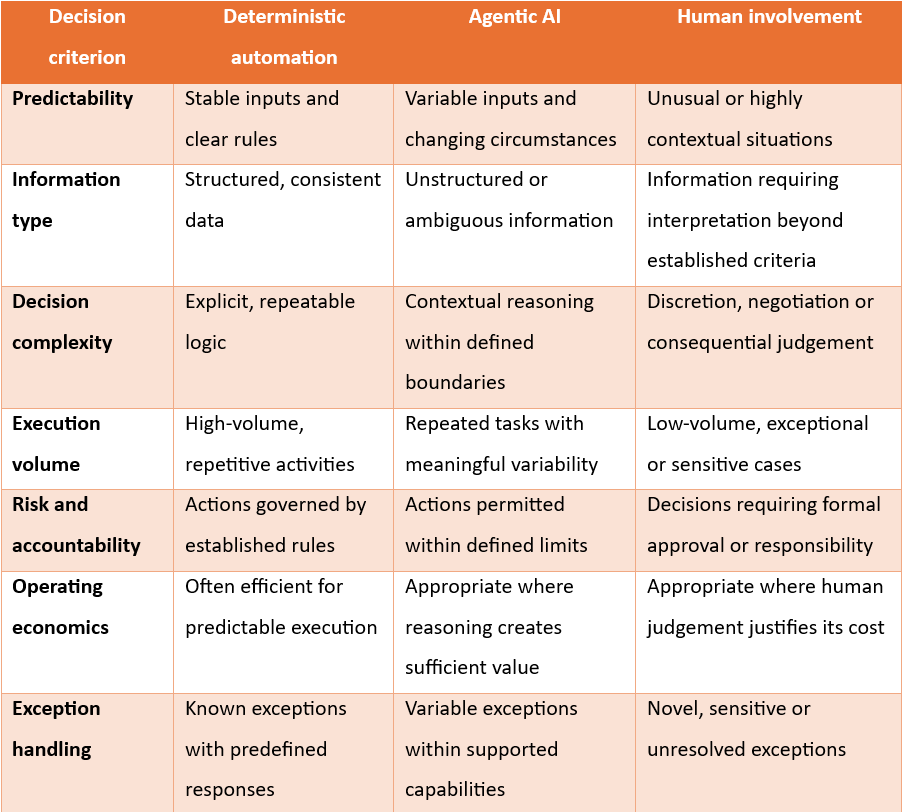
These categories are not mutually exclusive. A single activity may involve automation to retrieve information, AI to interpret it and a person to authorise the outcome.
The framework helps identify the most appropriate division of responsibilities rather than forcing every activity into one category.
Applying the framework: A customer onboarding example
Consider a financial services organisation processing business customer applications. Each application requires information collection, verification, document review, risk assessment and approval.
The organisation wants to reduce onboarding time while maintaining appropriate controls. Rather than assigning the entire process to an AI agent, it evaluates each activity individually.
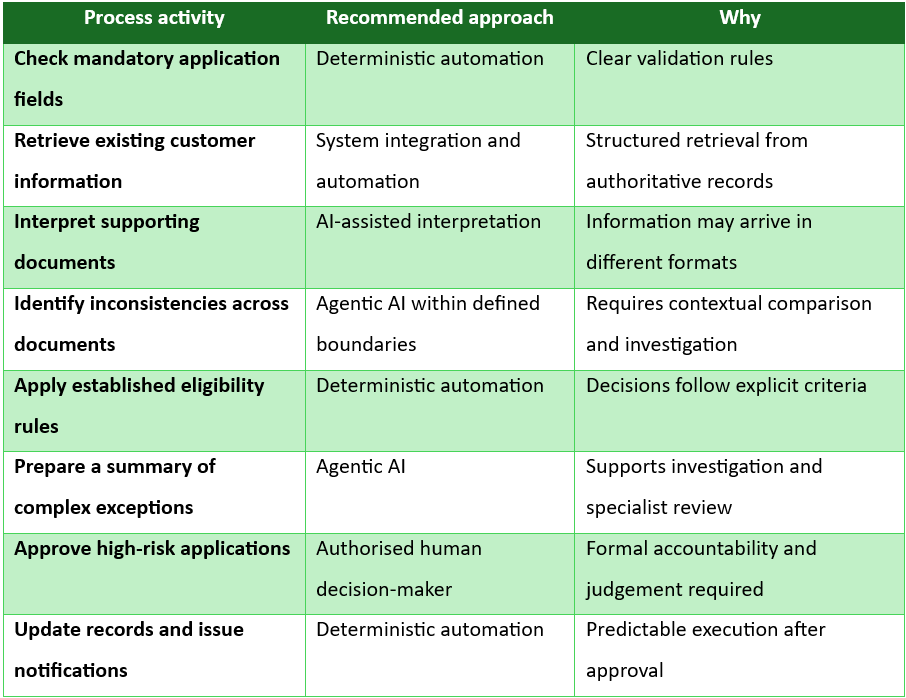
The result is a workflow that uses different capabilities according to the nature of the work. (This example is illustrative. Actual implementation decisions depend on system capabilities, risk requirements and organisational policies.)
The agent is not responsible for every activity, nor is the process dependent on complete AI autonomy. Instead, the organisation can introduce intelligent capabilities where they add value while retaining predictable automation and appropriate human oversight.
The economics of choosing the right capability
Technology selection also has financial implications.
A deterministic rule may execute at a relatively predictable cost. An AI agent may require model inference, retrieval, tool calls, monitoring and additional exception handling.
Human decisions involve labour costs, but they can also prevent expensive errors or resolve complex situations more efficiently than repeated automated attempts.
The appropriate comparison is therefore not simply the cost of executing one task. It is the total cost of achieving the required outcome. For example, an AI agent might complete an initial assessment more quickly than a human employee. But if its output frequently requires correction or escalation, the expected productivity benefit may be reduced.
Conversely, an agent that reliably handles a high volume of variable requests could reduce manual workload and improve processing capacity.
The economic case depends on factors such as volume, complexity, error rates, exception handling and the consequences of incorrect decisions.
This is why technology selection should be informed by operational evidence rather than assumptions about the superiority of one capability.
Match the level of autonomy to the task
Choosing agentic AI does not automatically mean granting the agent complete autonomy. Organisations can select different operating patterns according to the nature and consequences of the activity.
- Assist: The AI prepares information, identifies options or makes recommendations. A person remains responsible for taking action.
- Approve: The AI proposes an action, but an authorised person must approve it before execution.
- Act within limits: The agent can perform defined actions within established permissions and thresholds, escalating situations outside those boundaries.
- Autonomous execution: The agent can complete an approved workflow without routine human intervention, subject to appropriate controls, monitoring and exception handling.
These operating patterns allow organisations to introduce autonomy selectively.
A low-risk activity with clear boundaries may justify greater independence. A consequential decision may require explicit human authorisation regardless of the agent's technical capabilities.
The appropriate level of autonomy should reflect the value, reliability and risk of the specific activity.
Governance is part of the decision
The question of where work belongs cannot be separated from the question of what each capability is permitted to do.
As AI agents interact with enterprise applications, organisations need to establish boundaries around data access, system actions and decision-making authority.
Stanford University's 2026 AI Index Report highlights the continuing limitations of autonomous systems. On the OSWorld computer-use benchmark, leading agents achieved approximately 66.3% task success.
Although benchmark results should not be interpreted as enterprise failure rates, they illustrate why organisations must design for incomplete or unsuccessful execution. For an AI-enabled workflow, that means defining how failures are detected, how exceptions are escalated and which actions require additional approval.
Governance should be enforced through the application and workflow architecture, not left solely to instructions provided to the model. This enables organisations to use AI capabilities within clearly defined operational boundaries.
Design the process, not a collection of technologies
A successful enterprise workflow is not simply a collection of automated tasks, AI agents and human approvals. It is a coordinated operating process in which responsibilities are deliberately assigned, information moves between systems and exceptions are managed without losing visibility or accountability.
The design must also remain adaptable. As AI models improve, activities that currently require human involvement may become suitable for AI assistance or limited autonomy.
Equally, changing business requirements or risk conditions may require additional controls.
Organisations therefore need an architecture that allows individual capabilities to evolve without requiring the entire process to be redesigned.
This is where Clear Dynamics' approach to Governed Agentic Solutions becomes relevant. By combining process design, enterprise integration, intelligent automation and governance by architecture, Clear Dynamics helps organisations determine how different capabilities should work together within a managed business process.
The objective is to create an operating model that can deliver measurable outcomes while accommodating changes in technology and business requirements.
The best decision isn't always the most intelligent one
Agentic AI creates opportunities to automate work that previously required human interpretation and coordination.
But not every activity benefits from the same level of intelligence or autonomy. Some tasks are best handled through predictable automation. Others benefit from AI reasoning and adaptability. And some decisions should remain with people.
The strongest enterprise AI strategy is not the one that assigns the most work to agents. It's the one that assigns each activity to the capability best suited to delivering the required outcome.
Making those decisions deliberately can help organisations improve performance, manage costs and maintain accountability. And it creates a stronger foundation for introducing agentic AI into everyday business operations.
Frequently Asked Questions
Traditional automation executes predefined rules and workflows, making it suitable for predictable, repetitive activities. Agentic AI can interpret information, reason through variable situations and coordinate actions towards defined objectives. The appropriate choice depends on task complexity, predictability, cost and risk.
An AI agent may be appropriate when work requires interpretation, contextual reasoning or adaptability that cannot be efficiently handled through predefined rules. Traditional automation is generally preferable for stable, predictable tasks where consistency and low execution costs are priorities.
Human involvement is particularly important for decisions requiring formal accountability, discretion, empathy, negotiation or specialist judgement. AI can support these decisions by preparing information and recommendations, while authorised individuals retain responsibility for consequential outcomes.
The level of autonomy should reflect the activity's value, reliability and risk. Organisations can begin with AI assistance or human-approved actions, then consider limited or greater autonomy where performance evidence and appropriate controls justify it.
Yes. Enterprise workflows can combine deterministic automation for predictable tasks, agentic AI for interpretation and variable activities, and human involvement for exceptions or consequential decisions. Coordinating these capabilities allows organisations to optimise performance, cost and accountability across the complete process.
Ready for what comes next?
Ready to implement governed agentic AI into your organisation?
