

Governance by Architecture: Why AI Guardrails Need to Be Built Into the Application
Published:
03/11/2026
An AI agent can be instructed to follow the rules. But enterprise governance requires systems that enforce them.
An AI agent may be capable of accessing information, updating records or executing transactions across enterprise systems. But capability and authority are two very different things.
For CIOs, CTOs and CISOs, this distinction is fundamental.
As organisations introduce agentic AI into business-critical processes, they need to determine not only what an agent is designed to do, but what it is technically permitted to do.
An agent might be instructed not to modify sensitive customer information or initiate a transaction without approval. But if the underlying application gives it access to those functions, the potential for unauthorised action remains.
The question isn't simply whether an AI agent understands its boundaries. It's whether the application prevents it from crossing them.
This is the principle behind governance by architecture: designing enforceable controls into the applications and workflows in which AI agents operate, rather than relying solely on instructions or configurable policies.
Why instructions alone aren't enough
AI agents operate according to instructions that define their objectives, responsibilities and expected behaviour. These instructions are important, but they are not equivalent to technical access controls.
An agent can encounter unexpected inputs, ambiguous requests or malicious content that influences its behaviour.
For example, an agent processing supplier correspondence could encounter instructions embedded in an email or document that attempt to redirect its actions. This type of manipulation, commonly known as prompt injection, illustrates why organisations should not rely on model behaviour as their only line of defence.
The OWASP GenAI Security Project identifies excessive agency as a risk when AI systems are given more functionality, permissions or autonomy than their tasks require. An agent with unnecessary access to enterprise applications creates a larger potential impact if it behaves unexpectedly or is compromised.
The solution is not simply to write better prompts. It is to ensure that the application independently controls what the agent can access and execute.
Application-level governance:
A different approach to agent deployment
Many agentic AI implementations connect agents to enterprise systems through tools, APIs and shared execution environments. These environments can support permissions and security policies, but the strength of the controls depends on how they are designed, enforced and maintained.
Clear Dynamics' approach to Governed Agentic Solutions places the agentic workflow within a governed application architecture. The distinction is that the application establishes the operational boundaries within which the agent works.
Rather than giving an agent broad access to enterprise systems and relying on its instructions to restrict behaviour, the architecture can limit access to approved data, functions and integration pathways. Three design principles are central to this approach.
1. Application-specific boundaries
Each application should establish a defined scope for the information and functionality available to its AI-enabled workflow. An agent supporting supplier onboarding, for example, should not automatically have access to unrelated customer information or financial administration functions.
By limiting the agent's operating environment to the requirements of the application, organisations can reduce unnecessary access and help contain the impact of unexpected behaviour. This is particularly important when multiple AI-enabled processes operate across the enterprise. A problem within one workflow should not automatically expose unrelated systems or data.
2. Controlled integration gateways
AI agents often need to retrieve information or request actions from enterprise applications. A controlled integration gateway can provide a defined interface between the agentic workflow and those systems. Rather than allowing an agent to interact directly with every underlying application, the gateway exposes approved functions and applies relevant access and validation controls.
For example, an agent might be permitted to retrieve the status of an invoice through an approved interface. That does not mean it should also have permission to change supplier payment details or initiate a transaction. The integration layer can restrict which operations are available and validate requests before they reach the underlying systems. This separates the agent's reasoning capabilities from the authority to execute enterprise actions.
3. Defined data models and write permissions
Governed applications also need clear boundaries around the information an agent can create or modify. An application-specific data model, or schema, can define the information the workflow is responsible for managing. Write permissions can then be restricted to approved records and operations.
For example, an agent may be authorised to create an assessment record or update the status of a review. It may not be authorised to modify the underlying supplier master record or change financial account details. These restrictions should be enforced through the application and its supporting services.
The objective is to make unauthorised actions technically unavailable, rather than relying on the agent to choose not to perform them.
Five controls that make AI governance enforceable
Application boundaries provide the foundation, but effective governance also requires controls governing how work is executed.
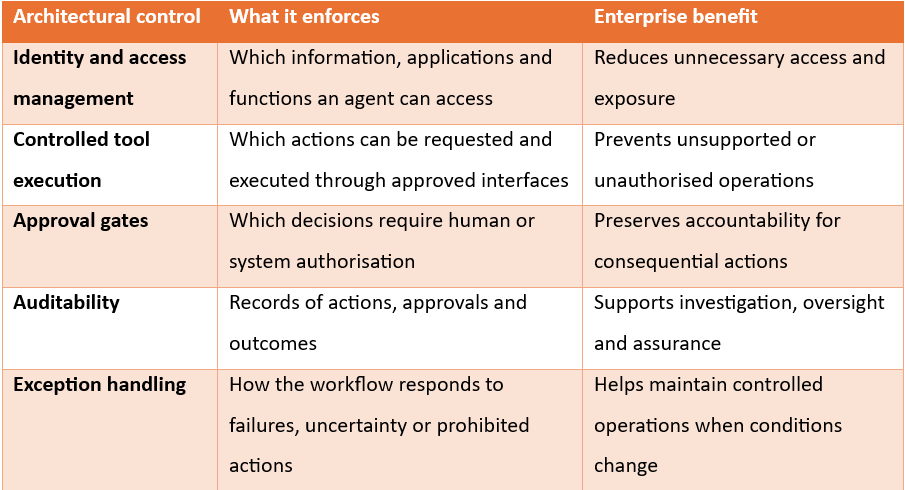
These controls are most effective when they operate independently of the AI model's instructions. An agent may propose an action, but the application should determine whether that action is permitted. If a request exceeds the agent's authority, the application should reject it or route it through the appropriate approval process.
This distinction allows organisations to introduce intelligent capabilities without transferring unrestricted control to the AI model.
What this looks like in practice: Supplier payments
Consider a finance team using an AI-enabled workflow to assist with supplier payment enquiries. The agent can interpret requests, retrieve invoice information, identify discrepancies and recommend actions to resolve common issues. These capabilities could improve efficiency and reduce manual investigation. But the organisation must distinguish between providing information, recommending an action and executing a financial transaction.
A governed application could establish the following boundaries:
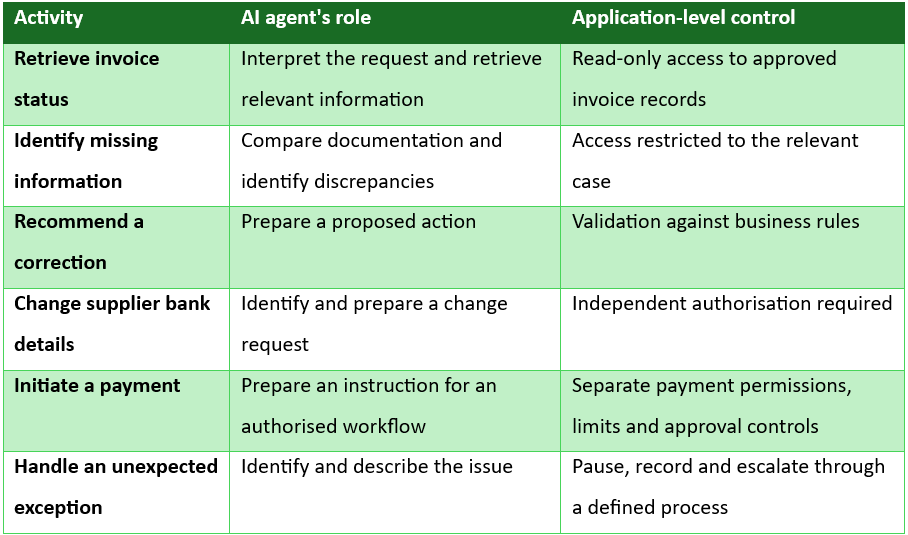
The agent can perform useful work without receiving unrestricted access to the organisation's financial systems. If it attempts an action outside its permissions, the application should prevent execution regardless of the agent's reasoning. (This example is illustrative and does not represent a specific Clear Dynamics customer deployment.)
This is the practical difference between behavioural guidance and architectural enforcement.
Why application isolation matters for enterprise risk
Application-level boundaries become particularly important as organisations deploy multiple AI-enabled workflows. Without appropriate separation, a shared execution environment or overly permissive integration can increase the potential impact of a compromised agent.
For example, an agent intended to manage customer service enquiries should not be able to access unrelated financial records simply because both systems are connected to the same broader AI environment. A well-designed architecture can restrict each workflow to the data and functions required for its responsibilities.
This follows the established principle of least privilege: granting only the access necessary to complete an authorised task. It also supports containment. If an agent behaves unexpectedly, the potential consequences can be limited by the permissions and integration boundaries surrounding it.
Application isolation is not a guarantee against every security threat. The effectiveness of the controls still depends on their implementation, configuration, testing and ongoing management.
However, it provides a stronger foundation for controlling AI behaviour than relying on instructions alone.
Governance must be maintained as the environment changes
Architectural controls are not a one-time implementation activity. Business rules evolve, systems change and new integrations may introduce additional permissions or dependencies.
Organisations therefore need to review access rights, test changes and monitor whether AI-enabled workflows continue to operate within their approved boundaries.
The National Institute of Standards and Technology's AI Risk Management Framework: Generative Artificial Intelligence Profile reinforces the importance of managing AI risks throughout the system lifecycle. For enterprise leaders, the implication is straightforward: governance requires both enforceable technical controls and ongoing organisational oversight.
Clear Dynamics' approach to governed agentic AI
Clear Dynamics' Governed Agentic Solutions offering is designed around the principle that AI governance should be built into the application architecture.
The approach combines business process design, intelligent automation, enterprise integration and managed delivery. Rather than treating the AI agent as an independent component with broad access to enterprise systems, the solution is designed around defined application boundaries and controlled interactions. This allows organisations to consider permissions, data access, approval requirements and operational oversight as part of the solution design.
The approach also supports flexibility as AI models and technologies evolve. By separating the intelligence used within a workflow from the controls governing its execution, organisations can change or improve AI capabilities while maintaining established business rules and authorisation requirements.
For CIOs, CTOs and CISOs, this is an important distinction. It means the organisation can evaluate the solution not only on the capabilities of the AI model, but on the architecture that determines how those capabilities operate within the enterprise.
The application must remain in control
Agentic AI is expanding the range of activities that enterprises can automate. But greater capability should not automatically mean greater authority.
An agent may be capable of performing an action without being authorised to perform it.
That distinction is fundamental to enterprise governance.
The strongest AI guardrails are not simply instructions telling an agent what it should do. They are controls built into the application that determine what it can do.
For organisations seeking to deploy agentic AI in business-critical environments, governance by architecture provides a practical foundation for combining intelligent capabilities with security, accountability and operational control.
Frequently Asked Questions
Governance by architecture is an approach that embeds enforceable controls into the applications and workflows in which AI agents operate. Rather than relying solely on prompts or behavioural instructions, it uses application-level permissions, integration boundaries and approval requirements to determine what agents can access and execute.
Application isolation restricts an AI agent's access to the data, systems and functions required for its assigned workflow. This can reduce unnecessary permissions and help contain the impact of unexpected or malicious behaviour. Its effectiveness depends on the strength of the underlying access controls and implementation.
An integration gateway provides a controlled interface between AI agents and enterprise systems. It can expose approved functions, validate requests and enforce permissions before actions reach connected applications, helping prevent agents from accessing or modifying information outside their authorised scope.
Prompts guide intended behaviour but do not independently enforce technical restrictions. AI agents may encounter ambiguous instructions, unexpected inputs or malicious content. Application-level controls provide a separate mechanism for restricting access and preventing unauthorised actions.
Organisations should regularly review permissions, test changes, monitor agent activity and reassess controls when applications, integrations or business requirements change. Effective governance combines technical enforcement with ongoing operational oversight.
Ready for what comes next?
Ready to implement governed agentic AI into your organisation?
