

Why We Don’t Start With the Agent
Published:
20/10/2026
Why We Don’t Start With the Agent
The most important decisions in an agentic AI implementation happen before an agent is selected.
When organisations begin exploring agentic AI, the conversation often starts with technology.
Which model should we use? What tasks could an agent automate? How much autonomy should it have? How quickly could we deploy it?
These are important questions. But answering them too early can lead organisations towards solutions that address individual activities without improving the way the business operates.
At Clear Dynamics, we take a different approach.
We start with the business process and the outcome it needs to deliver. Only then do we determine where automation, agentic AI and human judgement belong.
This isn't simply a philosophical preference. It's a practical approach to designing solutions that deliver measurable value, operate within enterprise constraints and can evolve as business requirements change.
Start by understanding the work
A business process is rarely as straightforward as it appears in a procedure document or workflow diagram.
Consider a customer onboarding process.
At a high level, the steps may appear simple: receive an application, validate information, complete checks, obtain approval and activate the customer.
But the operational reality may be considerably more complex.
Applications arrive through different channels. Information is incomplete or inconsistent. Employees move between systems to retrieve records. Some decisions follow clear rules, while others require investigation or judgement.
Exceptions may be handled through email, spreadsheets or informal processes that are not reflected in the official workflow.
Introducing an AI agent into one of these activities may create an improvement. But without understanding the surrounding process, it is difficult to know whether that improvement will translate into a better business outcome.
This is why process discovery matters.
Before deciding what an AI agent should do, organisations need to understand how work actually happens.
Five questions to ask before introducing an AI agent
A process-first approach begins with a structured assessment of the opportunity. At Clear Dynamics, our approach centres on understanding the business outcome, the workflow, the technology environment and the operational requirements that will shape the solution. Five questions help establish that foundation.
1. What business outcome are we trying to improve?
The first question should be commercial or operational, not technical. Is the objective to reduce processing time? Improve service quality? Increase capacity? Reduce errors? Lower the cost of completing a transaction?
A clearly defined outcome creates a basis for evaluating potential solutions. For example, an organisation may initially identify document review as an opportunity for AI.
But if the broader objective is to reduce customer onboarding time, accelerating document review may not deliver the expected benefit if applications continue to wait in approval queues.
The organisation needs to understand which activities are actually constraining the outcome. Establishing measurable success criteria also helps determine whether the proposed investment is justified.
2. How does the process operate today?
The next step is to map the current workflow, including the systems, people, decisions and dependencies involved. This should extend beyond the documented process to examine how work is performed in practice.
Useful areas of investigation include:
- Where work enters and exits the process.
- Which systems and data sources are involved.
- Where information is duplicated or manually transferred.
- Which activities create delays or rework.
- How exceptions are identified and resolved.
- Where approvals, judgement and accountability sit.
This assessment may reveal opportunities to simplify the process before introducing any new technology. Removing an unnecessary approval or eliminating duplicated data entry can sometimes deliver greater value than automating an existing activity.
The objective is not to preserve every step of the current workflow. It is to understand which steps are necessary to deliver the desired outcome.
3. Which activities require intelligence, and which require certainty?
Once the process is understood, organisations can determine how different activities should be performed.
Some activities are predictable and governed by clearly defined rules. These may be well suited to deterministic automation. Others involve interpreting unstructured information, navigating ambiguity or adapting to changing circumstances. These may benefit from agentic AI.
Certain decisions require human judgement, formal accountability or specialist expertise. The distinction is important because different capabilities have different operating characteristics, costs and risks.
An agent that interprets a complex document may create considerable value. Using the same agent to execute a simple, repeatable calculation may introduce unnecessary complexity.
The goal is to select the most appropriate capability for each activity, rather than maximise the number of tasks performed by AI.
4. What constraints must the solution operate within?
Enterprise processes operate within established technology, security and governance environments. A proposed AI solution must account for these requirements from the outset.
For example, an agent may need access to customer records in a CRM, information held in a document management system and transaction data stored in another application. The organisation must determine how those systems will interact, which information can be accessed and what actions the agent is permitted to perform.
There may also be regulatory requirements, internal policies, approval thresholds and data-handling obligations that shape the design.
These are not simply issues to resolve during deployment. They influence which solutions are appropriate in the first place. An opportunity that appears technically straightforward may require significant integration or governance work. Understanding these dependencies early helps organisations make more informed investment decisions.
5. How will the process be operated and improved?
An AI-enabled process needs an operating model, not just an implementation plan. Who will monitor its performance? Who will manage exceptions? Who can approve changes to the workflow? What happens when a connected system fails or the AI produces an unexpected result?
These questions should be answered before deployment. Organisations also need to consider how the process will evolve.
Business rules change, systems are upgraded and new AI capabilities become available. A solution designed around a single model or tightly coupled integration may become difficult to maintain. Designing for ongoing support and change helps protect the long-term value of the investment.
Turning process discovery into solution design
Once these questions have been addressed, the organisation has a stronger foundation for deciding how AI should be introduced.
Consider an illustrative supplier onboarding process. During discovery, the organisation identifies that applications are delayed by three recurring issues: incomplete documentation, repeated manual checks and complex exceptions requiring specialist review.
Rather than assigning the entire process to an AI agent, the solution could be designed around the nature of each activity.
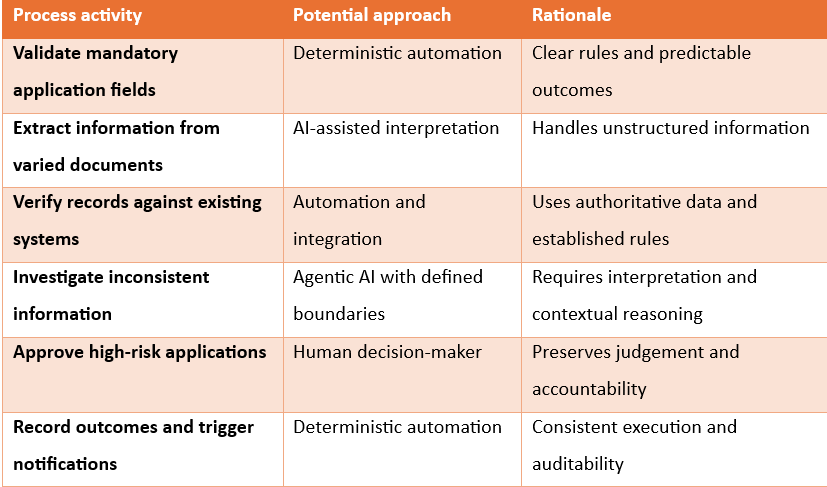
The resulting workflow combines different capabilities within a coordinated process. (The example is illustrative. Actual implementation choices depend on business requirements, system capabilities and risk considerations.)
Importantly, it also creates opportunities to eliminate unnecessary activities, improve information flow and establish clearer ownership of exceptions. This is where process discovery becomes solution design.
Why this approach matters for enterprise AI investment
The importance of process redesign is increasingly reflected in enterprise AI research.
McKinsey's State of AI in 2025 research found that organisations achieving the strongest AI outcomes were substantially more likely to fundamentally redesign workflows than other respondents. The finding highlights a distinction between introducing AI into existing activities and rethinking how work should be performed.
Stanford University's 2026 AI Index Report also illustrates the growing maturity of AI adoption. While 88% of surveyed organisations reported using AI in at least one business function, agent deployment remained at an earlier stage.
As organisations move towards more advanced implementations, the challenge is not simply identifying what AI can do. It is determining where AI can be applied effectively within the business, what supporting capabilities are required and how the resulting process will be managed.
A process-first approach provides a practical framework for making those decisions.
How Clear Dynamics approaches the opportunity
Clear Dynamics' Governed Agentic Solutions offering begins with understanding the process and identifying the business outcome the organisation wants to achieve.
From there, the approach considers how to design the target workflow, select the appropriate capabilities and establish the architecture required for implementation. This includes evaluating the role of deterministic automation, agentic AI, enterprise applications and human oversight.
It also involves considering the economics and operational requirements of the complete solution.
The approach is model- and framework-agnostic, allowing technology choices to be guided by business needs rather than a predetermined AI platform.
Through managed delivery, Clear Dynamics supports the lifecycle from discovery and design to implementation, deployment and ongoing optimisation.
The result is an approach focused on building business capabilities rather than introducing technology for its own sake.
Better questions lead to better AI decisions
Agentic AI creates opportunities to improve business operations, but the quality of the outcome depends on the decisions made before implementation begins.
Starting with the agent can narrow the conversation to what a particular technology is capable of doing.
Starting with the process opens a more valuable discussion about how the business should operate, what needs to change and which capabilities can deliver the desired outcome.
The best place to begin an agentic AI initiative isn't with a model, a tool or a demonstration. It's with a clear understanding of the work and the outcome worth improving.
That's why Clear Dynamics doesn't start with the agent. We start with the process.
Frequently Asked Questions
An agentic AI process assessment examines an existing business workflow to identify where intelligent automation could improve outcomes. It considers the process, systems, data, operational constraints and governance requirements before recommending appropriate technologies.
Assessing the process first helps organisations identify the underlying causes of inefficiency, determine which activities genuinely require AI and avoid automating unnecessary work. It also establishes measurable objectives for evaluating the proposed solution.
An assessment typically considers process documentation, transaction volumes, performance measures, existing systems, data sources, manual activities, exception handling, approval requirements and operational constraints.
Suitable opportunities often involve valuable business outcomes, repetitive workloads, multiple systems or activities requiring interpretation and contextual reasoning. The assessment should also consider data accessibility, integration feasibility, implementation costs and the consequences of errors.
The findings can inform the design of an improved workflow, including the selection of automation, AI and human responsibilities. They can also support a business case, architecture requirements, implementation priorities and a roadmap for deployment.
Ready for what comes next?
Ready to implement governed agentic AI into your organisation?
